If gyms feel like too much noise and programmes never survive week three, the problem probably isn't you. Here's how I coach people with ADHD in Cambridge.
A lot of the people who get the most from one-to-one coaching are the ones who've already written themselves off. They've joined gyms and stopped going by February. They've downloaded programmes that lasted eleven days. They've been told — by trainers, by fitness culture, by themselves — that they just lack discipline. Most of the time, that diagnosis is wrong. The plan was built for a person who doesn't exist: someone with the same energy, focus and motivation every single week.
If you have ADHD — diagnosed, suspected, or just a brain that gets bored fast and abandons routines — that person definitely isn't you. So the training has to be built differently.
What ADHD-friendly actually means here
It's not a marketing label. It's a set of practical decisions about how sessions run:
- One-to-one, always — no group noise, no comparing yourself to the person on the next bench
- The same coach, the same place, the same time each week — the routine carries you, not willpower
- A clear plan for the session, so you never have to decide what to do — deciding is the hard part
- Variety inside the structure — the stimulus changes, the container doesn't
- No shouting, no tough-love act, no pretending a bad day didn't happen
The plan bends. It doesn't break.
Every session starts with a simple question: how are you today, actually? If the answer is "slept badly, brain's foggy, everything feels like effort" — the session changes. Lighter, shorter, more familiar movements, a win you can leave with. If the answer is "fired up" — we use it. The programme keeps moving either way, which is exactly what a printed plan can't do.
This is the part most people with ADHD have never experienced from a trainer: the bad day isn't a failure to be pushed through or punished for. It's just information, and the session adapts to it.
Why strength training suits the ADHD brain
Strength work is built from short, completable chunks — a set of five, a rest, another set. Each one has a clear start, a clear end and immediate feedback. There's variety within every session and measurable progress week to week: more weight, an easier movement, better control. For a brain that runs on interest and visible reward, that structure works far better than forty minutes of the same treadmill.
What the first sessions look like
We start with a conversation and a movement assessment — not a fitness test. There's no passing or failing; I'm looking at how you move so the programme starts in the right place. From there, sessions follow the same simple shape every week: a warm-up, the main work, and a finish. You'll always know what's coming next, and you'll never be asked to do something without knowing why.
Where and when
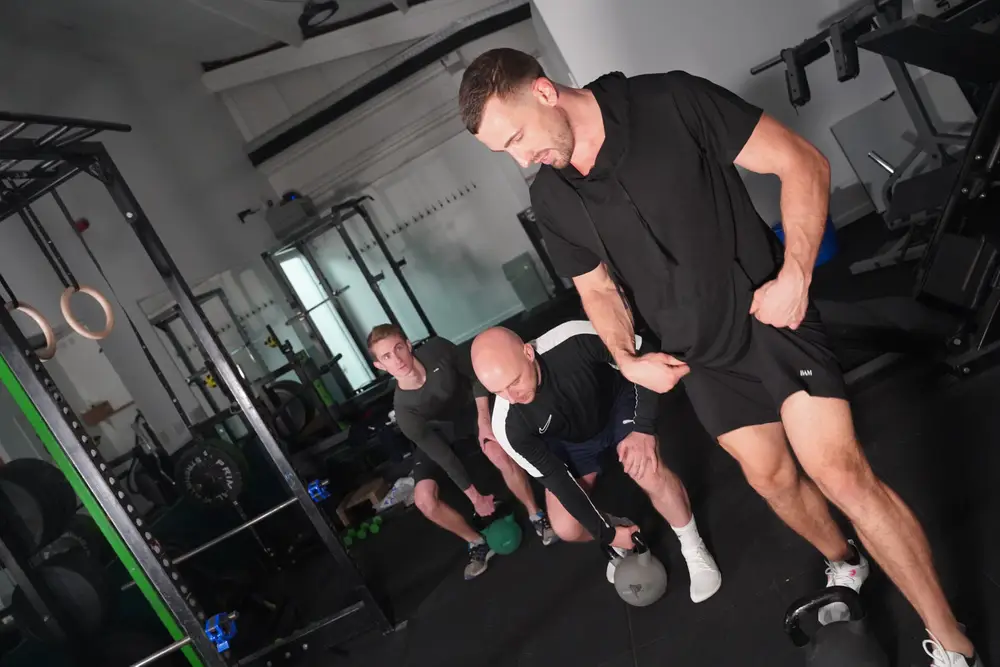
Sessions are at Kelsey Kerridge Sports Complex in central Cambridge, booked at quieter times of day where possible — no audience, no waiting for equipment. The space is simple: barbells, dumbbells, open floor. If the gym ever feels like too much, we adjust.
A note on honesty
I'm a coach, not a clinician, and training isn't treatment. But exercise is one of the most reliably helpful things most people with ADHD can do for energy, mood and focus — and a good coach removes the two biggest barriers: deciding what to do, and doing it alone. If you've tried to train before and it didn't stick, that history is exactly why one-to-one exists.
If this sounds like the way you need training to work, the next step is a conversation — book a discovery call and we'll talk it through.
Common questions
- What makes personal training ADHD-friendly?
- Structure without rigidity: a clear plan for every session, the same coach and place each week, and the flexibility to change the plan on the day when energy or focus is low. No shouting, no guilt, no pretending a bad day didn't happen.
- I've quit every programme I've started. Will this be different?
- Most programmes fail because they expect the same person to show up every week. Coaching adapts the session to whoever actually walks through the door — good day or bad — which removes most of the reasons people quit.
- Is the gym environment overwhelming?
- Sessions are one-to-one at Kelsey Kerridge in Cambridge, booked at quieter times where possible. There's no audience, no waiting for equipment, and no pressure to look like you know what you're doing.
- Do I need to tell you I have ADHD?
- Only if you want to. The way I coach — clear structure, variety within a plan, no judgement — suits most people. If you do tell me, it simply helps me tailor the sessions better.
Written by Thomas Beeston, holistic strength coach at Strength by Design.
Apply this approach through in-person coaching in Cambridge or online coaching worldwide.