Squats, presses and rows all move in straight lines. Real life doesn't. Here's what happens when you train the diagonals instead.
Almost everything in a standard gym programme happens in one plane. You squat down and stand up. You press up. You row back. All useful, all straight lines. Then you carry a suitcase up stairs, twist to lift a child out of a car seat, or throw something — and none of it looks like the training.
The body is not built in straight lines. Muscle wraps around the torso in spirals, and force travels diagonally: opposite hip to opposite shoulder. That is how walking works. It's how running works. Train only in one plane and you get strong in a way that doesn't transfer.
Posture comes first
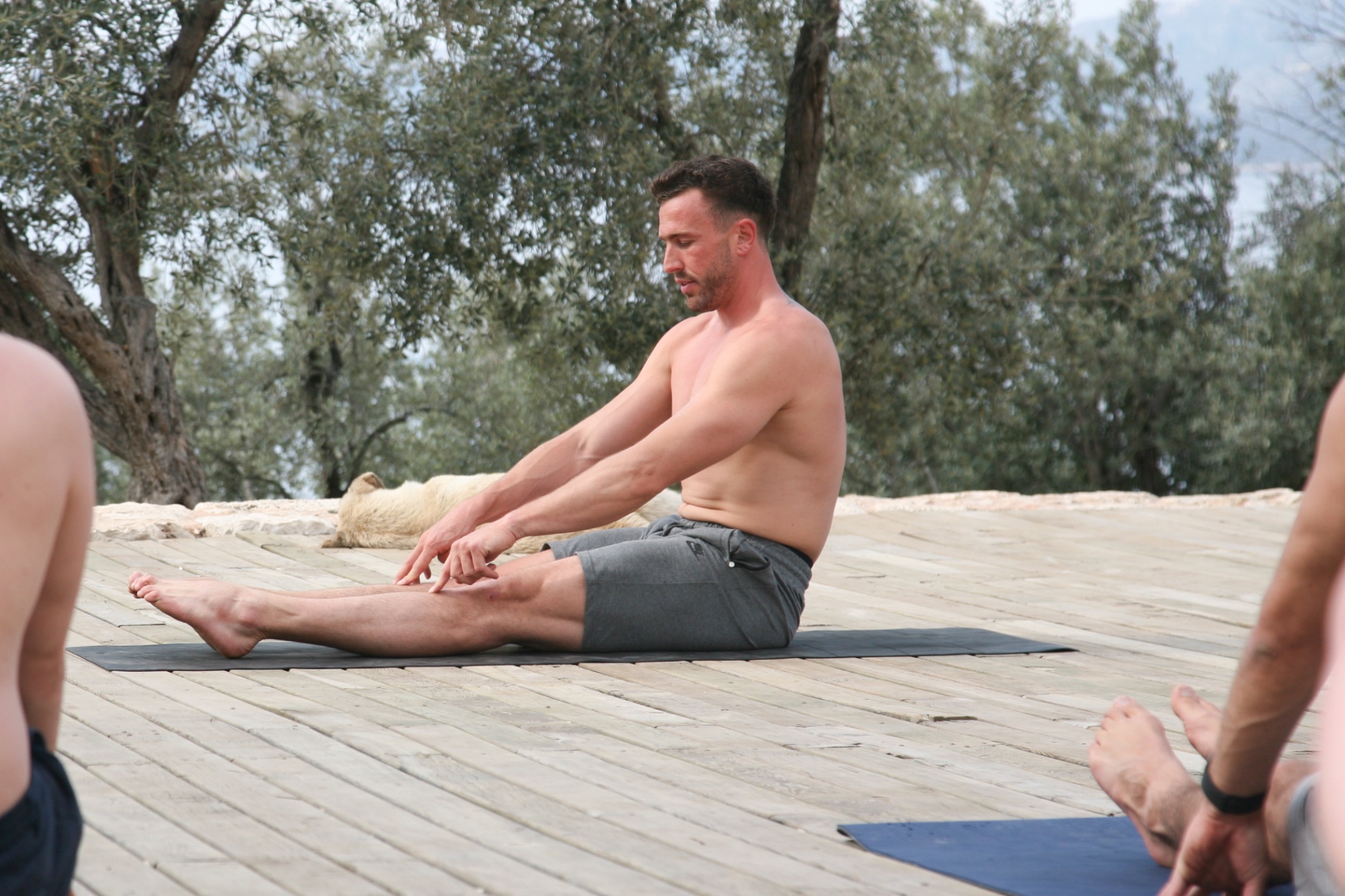
Before any rotation is worth loading, the position has to be right: hips sitting slightly behind the shoulders, spine tall, weight settled back. That posture is what puts you into your glutes rather than your lower back or quads. Get it wrong and the rotation happens where it shouldn't — in the lumbar spine — which is exactly where people get hurt.
The chain, and where it breaks
Force runs through a chain: the foot and ankle feed the knee, the knee feeds the hip, the hip feeds the torso, and the torso feeds shoulder rotation. Break any one link and the rotation stops transferring — the arms end up doing work the hips should have done. Most shoulder niggles I see in rotational sport are a hip or ankle problem wearing a disguise.
Counterlateral: the pattern underneath everything
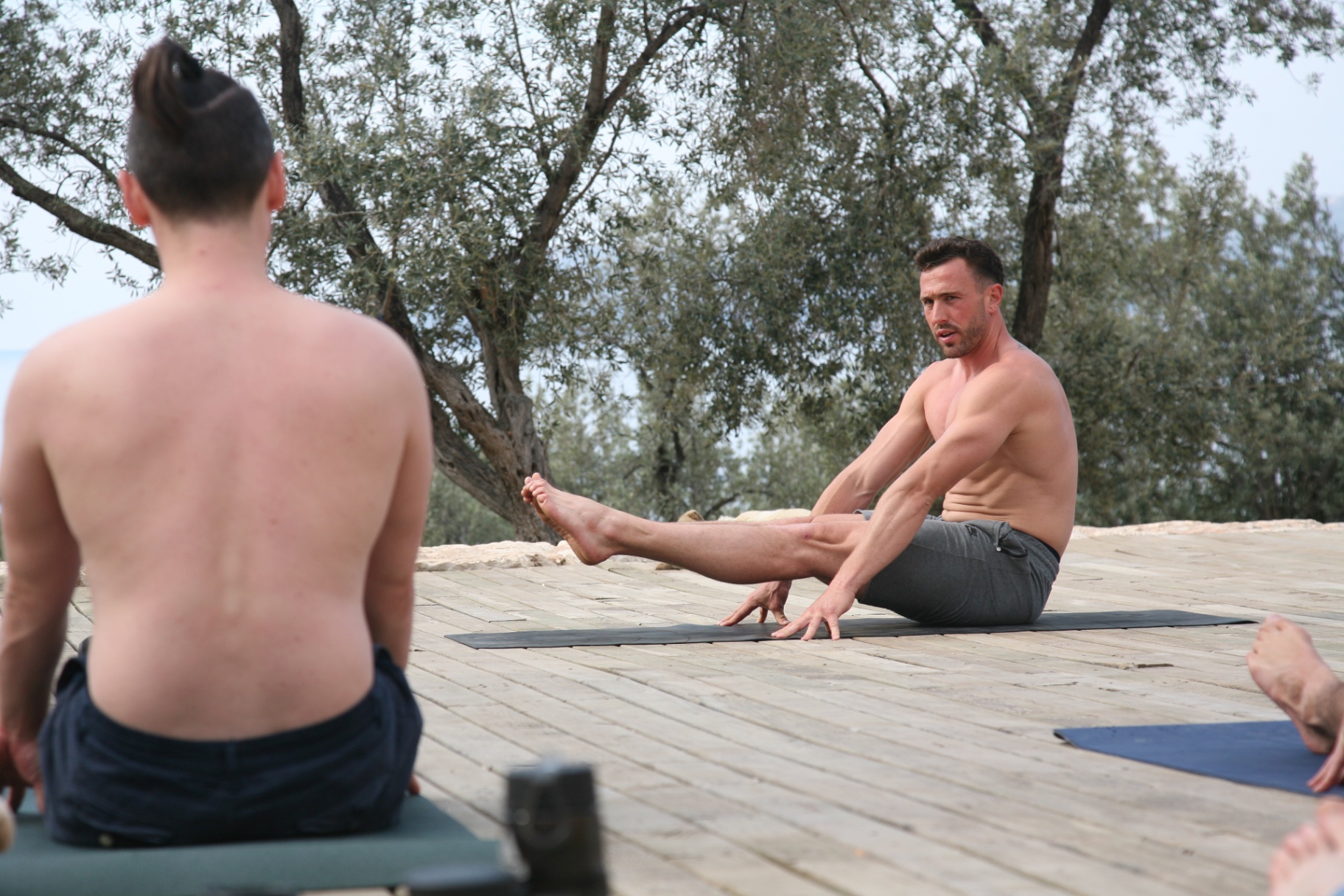
Opposite arm, opposite leg. It is how you have walked since you were a toddler, and it is the pattern I build almost everything around. Loaded, it teaches the body to send force diagonally across the trunk instead of bracing rigidly and hoping.
The tissue doing that work is often called the oblique slings — the spiral lines that run from one glute, across the back, to the opposite shoulder, and the mirror image across the front. When they're doing their job, rotation feels effortless and cheap. When they're not, everything is muscled.
What it looks like in a session
- Warm-up that rotates, not just stretches — trunk pivots where the foot and hip turn with the spine, arm swings that load and decelerate the front line, leg swings to open the hips
- A light counterlateral pattern first — a dumbbell step-through swing, opposite arm leading the opposite leg, hips and shoulders turning together
- Rotational pulling — a cable or strap pull that becomes a rotation, torso opening rather than arms yanking, feet staying square and grounded
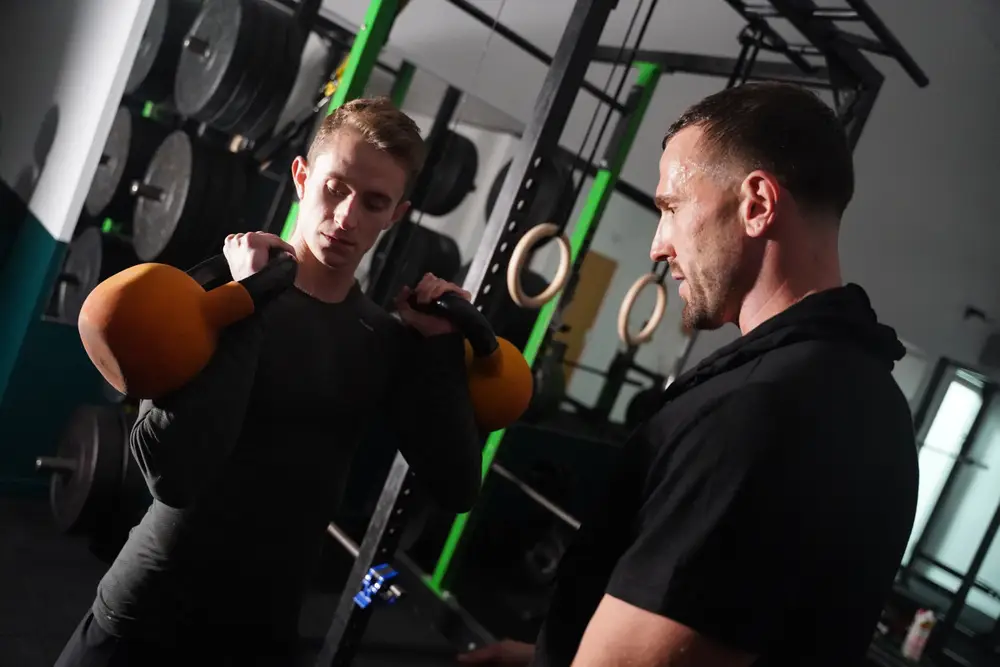
- Loaded hip rotation — a kettlebell swing into a step-through lunge, rotating over the lead leg so the sling catches the turn
- Power output last — a rotational clean and press, slam or landmine variation where the weight transfer onto the lead leg drives everything
Lead leg dominance
Shifting weight laterally onto the lead leg sits behind almost all of it — lunges, step-throughs, switch steps. That weight transfer is what loads the sling before it fires. If someone's rotational work looks weak, nine times out of ten they never got their weight over the front leg; they turned from the top and left the ground out of it.
The cue I repeat most
Hips back, chest tall, opposite arm drives opposite leg, rotate through the torso and not the low back. Almost everything in this style of training is a variation on that sentence.
Why it matters if you're not an athlete
This isn't a sports-performance niche. The person who benefits most is usually the one who sits at a desk all week and then does something ordinary and awkward at the weekend. A body that can rotate, transfer load and absorb it is a body that copes with garden lifting, luggage, kids and stairs. That is the whole point — strength you can use, in a body that feels good to be in.
How to start
Keep your usual squat, hinge, press and pull. Add one rotational pattern per session, unloaded or very light, and treat it as a skill for the first month. Slow, controlled, feeling where the movement comes from. Load it once it looks the same on both sides.
If you'd rather not guess, this is what an assessment is for — I look at how you move before deciding what to load. One-to-one coaching in Cambridge, first conversation free.
Common questions
- What is 3D or rotational training?
- Training that loads the body in all three planes — forwards and back, side to side, and rotation — rather than only the straight-line patterns most gym programmes use. It reflects how the body is actually built to move and transfer force.
- Is rotational training safe for your back?
- Trained properly, yes — and it usually helps. Problems come from rotating through a stiff lower back instead of the hips and mid-back. Coached, the rotation comes from the torso and hips while the lumbar spine stays comparatively quiet.
- Do I need to be athletic to train this way?
- No. The patterns are just walking, reaching and turning, loaded. Beginners start unloaded and slow; the movement is the point, not the weight.
- Will rotational work replace normal strength training?
- No, it sits alongside it. You still want a strong hinge, squat, press and pull. Rotational work makes that strength usable outside the gym.
Written by Thomas Beeston, holistic strength coach at Strength by Design.
Apply this approach through in-person coaching in Cambridge or online coaching worldwide.