Plenty of desk-bound people leave the gym tighter than they arrived. The fix isn't working harder — it's training in more than one direction.
Most people go to the gym to feel better in their body. Yet a lot of desk-bound professionals in Cambridge leave their workouts feeling tighter, stiffer and more beaten up than when they walked in. Usually it isn't a lack of effort. It's that most gym training only moves in straight lines.
The fixed-track trap
Eight hours at a screen and a hunched cycle home already keep your hips, spine and shoulders in one shape all day. Locking into fixed machines or pressing in a straight line on a flat bench adds load to a frame that is already restricted. You build muscle, but you also reinforce the stiffness you came to get rid of.
Your body is built to rotate, absorb force and adapt in every direction. When training only ever goes up and down, your joints pick up the bill.
Three things missing from most routines
1. Loaded carries
Nothing teaches your ribcage, pelvis and feet to work together like picking up a weight in one hand and walking with intent. A suitcase carry builds more useful trunk strength than hundreds of crunches, without folding your lower back.
2. Rotation and diagonals
Real life happens in rotation — lifting a bag into the boot, picking up your kids, checking over your shoulder on the bike. If your training has no controlled rotation, your lower back ends up doing the turning your mid-back and hips should.
3. One side at a time
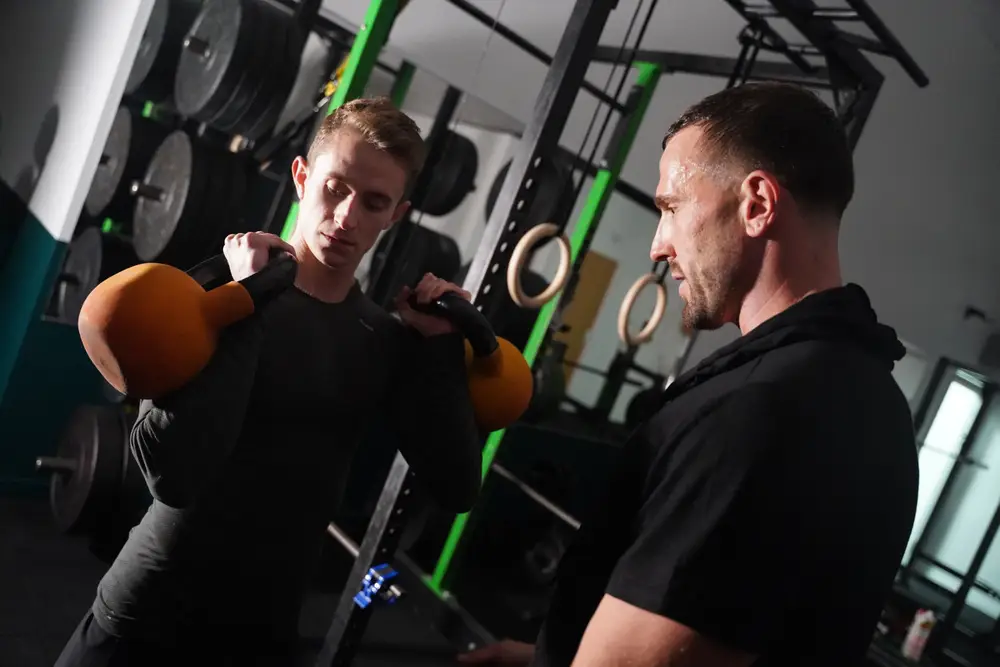
Most people have a stronger hip, an old ankle sprain or one shoulder that sits higher. Two-handed lifts let the stronger side quietly cover for the weaker one. Split squats, single-leg hinges and one-arm kettlebell work bring the difference into the open so you can even it out.
A simple test for your training
After your next session, ask yourself: do you feel compressed and brittle, or open, grounded and capable? Good strength work should make life outside the gym easier — not leave your back complaining every Thursday morning.
Want to see how you move in every direction? Start with a free discovery session at Kelsey Kerridge.
Let's trainCommon questions
- Does this mean barbells and machines are bad?
- No. They are great tools for building strength under load. They just shouldn't be the whole menu, especially if your goal is moving well for decades without aches.
- How often should I train rotation and carries?
- A little every session. A couple of sets of loaded carries and some controlled rotation fit easily into a warm-up or the end of a workout.
Written by Thomas Beeston, holistic strength coach at Strength by Design.
Apply this approach through in-person coaching in Cambridge or online coaching worldwide.